at what age can a child choose which parent to live with in missouri
i in 4 states don't require judge to consider child'southward custody preference
Nov 17, 2020 — Many separating parents mistakenly think their child can choose whom to live with.
In reality, Georgia is the only U.South. state that lets a child choose who takes physical custody of them. Fifty-fifty so, the child must be fourteen or older, and their pick must be approved by a judge.
Xiii states don't have statutes requiring a judge to consider a child's preference when deciding custody. All other states (plus Washington, D.C.) do; judges in that location must accept the views of mature children into account.
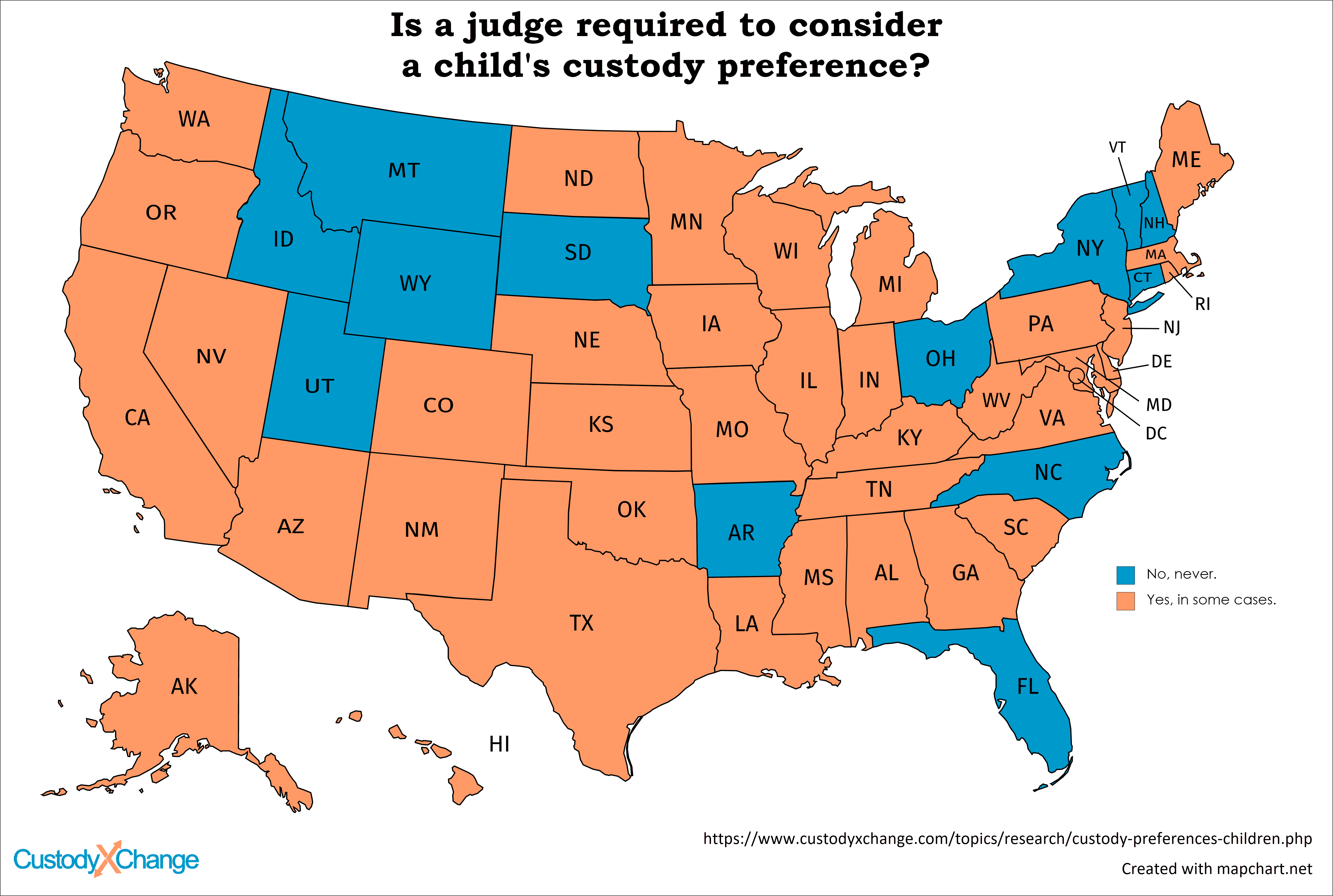
Download: PNG | JPG Use image with attribution
These findings come from an analysis of current state statutes by Custody X Change, which offers parents a web app for managing custody via parenting plans, calendars, expense tracking and more. (Curlicue to end for full state-past-state data.)
"If you go to court over custody, you need to sympathize your state'southward approach to many topics, including a kid'due south right to share their stance," said Ben Coltrin, Custody X Change co-founder and president. "There'southward argue over what'south more important: letting a child have a say or shielding them from parental disputes. How your land and approximate view the issue will impact your instance."
"There'south debate over what's more important: letting a kid accept a say or shielding them from parental disputes."
-Ben Coltrin, Custody Ten Alter president
Information technology's important to note that most custody decisions are made by parents in settlement agreements; these parents tin can consider their child's opinion however they desire. When parents can't reach agreement, then a judge decides what custody organization would serve the child'due south all-time interests.
In one case the court issues a custody gild, the child must comply. This means your son or daughter cannot reject to encounter a parent who has been awarded custody or visitation time.
How erstwhile must a child be to counterbalance in?
All states allow judges to consider the preference of a kid in a custody instance, as long equally the kid is sufficiently mature. And, equally we saw in a higher place, a big portion of states require judges to take a mature child'southward opinion into account.
So when is a child mature? Near states don't set a specific age, instead letting judges decide case past case.
When statutes do cite an age, 14 is most mutual. Three states (California, New Mexico and Westward Virginia) presume children 14 and older are sufficiently mature, while two (Indiana and Utah) requite extra weight to the opinions of kids in this range.
Another four states (Mississippi, Oklahoma, Tennessee and Texas) presume children 12 and upwards are mature enough to form a preference worth examining.
Georgia law sets the youngest age. It says children 11 and upwardly can share their thoughts with the court. (And, remember, Georgia kids at least xiv years old tin cull which parent to live with, although a guess can override the choice if necessary.)
All these states give judges leeway to hear from younger children who seem especially mature.
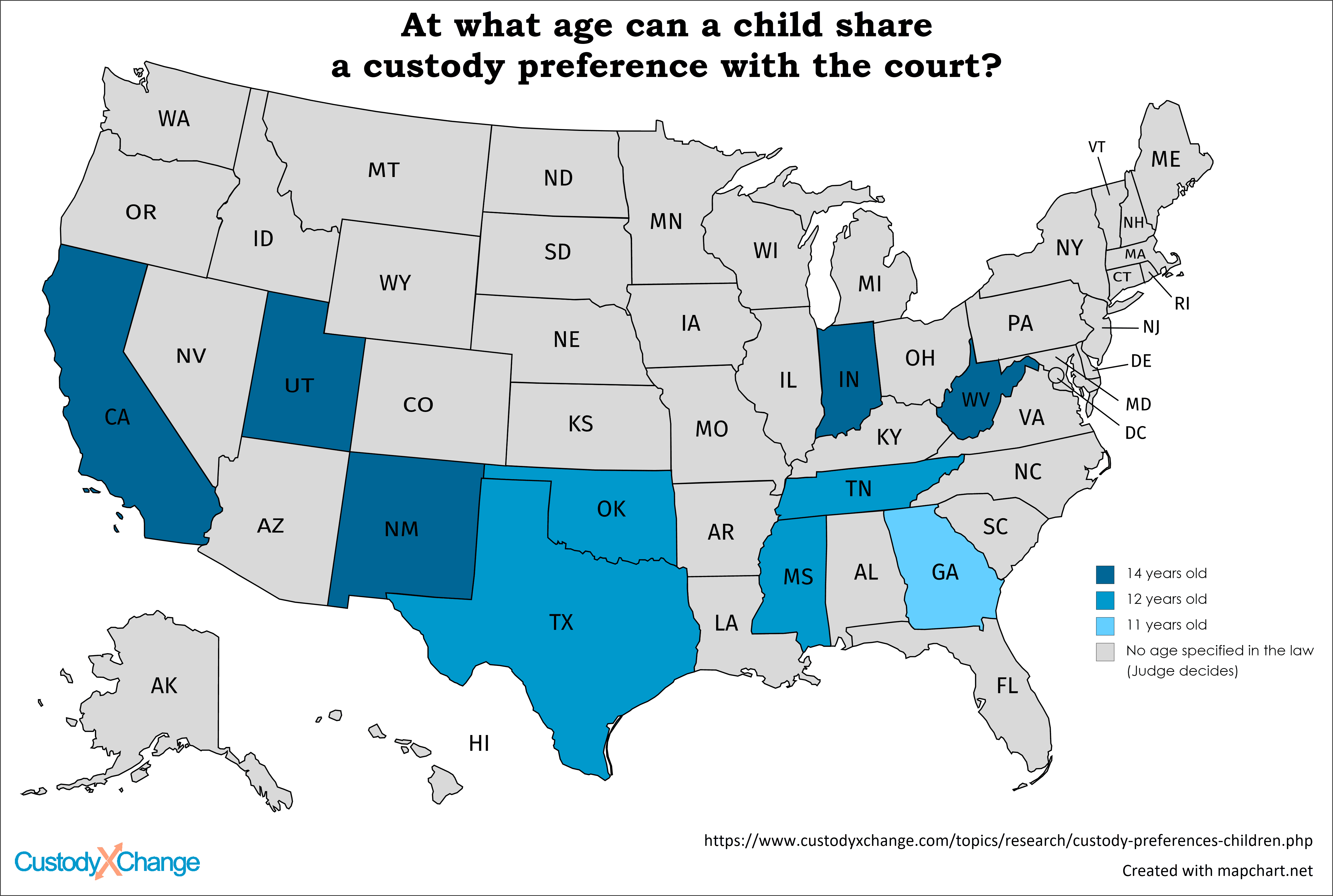
Download: PNG | JPG Apply prototype with attribution
Overall, the older a child is, the more impact their wishes have on their custody example.
If your child is at to the lowest degree 14, a judge in any state is likely to hear what they have to say. On the other hand, a child in the single digits probably won't get to weigh in. Children betwixt these two groups fall in a gray area, and whether they can provide input depends on their state, guess and maturity level.

Nationwide, children 14 and above can ordinarily weigh in on custody rulings. Children 9 and under unremarkably can't. The balance fall in a grey area.
How a kid'southward opinion fits into the large picture
A judge never has to award custody according to a child's wishes. Other factors — such as each parent's criminal history and bond with the child — always come into play.
In addition, a judge tries to appraise whether a child's preference for 1 parent is due to persuasion or leniency by that parent, which would requite the preference less validity from the court's perspective.
For example, a 15-year-onetime may non get to alive with her mom as she wishes if show shows the mother lets her drive without a license. In dissimilarity, a 12-yr-old with concrete reasons for preferring a suitable parent could have considerable influence on a judge's ruling.
How kids share their opinions
Children typically practise not testify almost their preferences in courtroom because the experience can be emotional and frightening.
Instead, they usually share their thoughts in conversation with the judge, a custody evaluator or someone appointed by the courtroom to represent their interests (like a guardian ad litem). In Georgia, a child who's at least 11 tin can plough in a written affidavit.
Interviews with the guess take place in the judge'due south part and are thus known as in-chambers or in-camera hearings. Generally, a courtroom reporter and the child'due south legal representative nourish. Sometimes the parents' attorneys are also immune in simply not the parents themselves.
Some judges ask the kid direct whom they'd similar to alive with, while others only inquire related questions like, "What exercise you lot do for fun with your mom?" In sure states, both parents must consent before the child may speak with a judge. Other factors that vary include whether parents can suggest questions for the interview and whether they can read the transcript.
State-past-state information
| Land | Guess must consider a mature kid's opinion? | Age guidelines in the law |
| Alabama | Aye | |
| Alaska | Yep | |
| Arizona | Yes | |
| Arkansas | No | |
| California | Yes | A child 14 or older gets to accost the court, unless the court determines it'south not in the child's all-time interest. A child under 14 too gets to address the court if it's in their all-time interest. |
| Colorado | Yes | |
| Connecticut | No | |
| Delaware | Yeah | |
| Florida | No | |
| Georgia | Yeah | A kid xiv or older has the right to select which parent they live with, unless a estimate finds the selected parent does not serve the child'south best interests. The judge considers the desires of a child at least 11 but not still 14. |
| Hawaii | Yes | |
| Idaho | No | |
| Illinois | Aye | |
| Indiana | Yes | The court considers the wishes of the child, with more than consideration given if the child is at least 14. |
| Iowa | Yes | |
| Kansas | Yeah | |
| Kentucky | Yes | |
| Louisiana | Yes | |
| Maine | Yes | |
| Maryland | Aye | |
| Massachusetts | Yes | |
| Michigan | Aye | |
| Minnesota | Aye | |
| Mississippi | Yeah | If the court considers both parents fit to accept custody, the chancellor (approximate) may consider the preference of a child 12 or older. |
| Missouri | Yep | |
| Montana | No | |
| Nebraska | Yeah | |
| Nevada | Yep | |
| New Hampshire | No | |
| New Bailiwick of jersey | Yes | |
| New United mexican states | Yes | If the kid is 14 or older, the court considers their desires. If the child is under 14, the courtroom decides custody per the kid's best interests, because factors like the child's wishes. |
| New York | No | |
| North Carolina | No | |
| North Dakota | Yes | |
| Ohio | No | |
| Oklahoma | Yes | The kid gets to express a preference if the court finds this is in the kid's best interest. The court considers the preference if the child is old enough to form an intelligent opinion. There'south a presumption a child 12 or above is old plenty. |
| Oregon | Yep | |
| Pennsylvania | Yes | |
| Rhode Island | Yes | |
| Due south Carolina | Yes | |
| South Dakota | No | |
| Tennessee | Yes | The court considers the reasonable preference of a child 12 or older. The court may hear the preference of a younger child. An older kid's preference is normally given greater weight. |
| Texas | Yes | A kid 12 or older gets to speak with the courtroom in private. A child nether 12 may become to. |
| Utah | No | The court may consider the wishes of the child, because the child's maturity. The desires of a kid 14 or older get added weight. |
| Vermont | No | |
| Virginia | Aye | |
| Washington | Yes | |
| Washington, D.C. | Yes | |
| West Virginia | Yeah | The court accommodates the preferences of a child 14 or older, if information technology'southward in the child'south best interests. It too accommodates the preferences of a younger kid mature plenty to express an opinion, as long as this is in the child's best interests. |
| Wisconsin | Yeah | |
| Wyoming | No |
Source: https://www.custodyxchange.com/topics/research/custody-preferences-children.php

Post a Comment for "at what age can a child choose which parent to live with in missouri"